
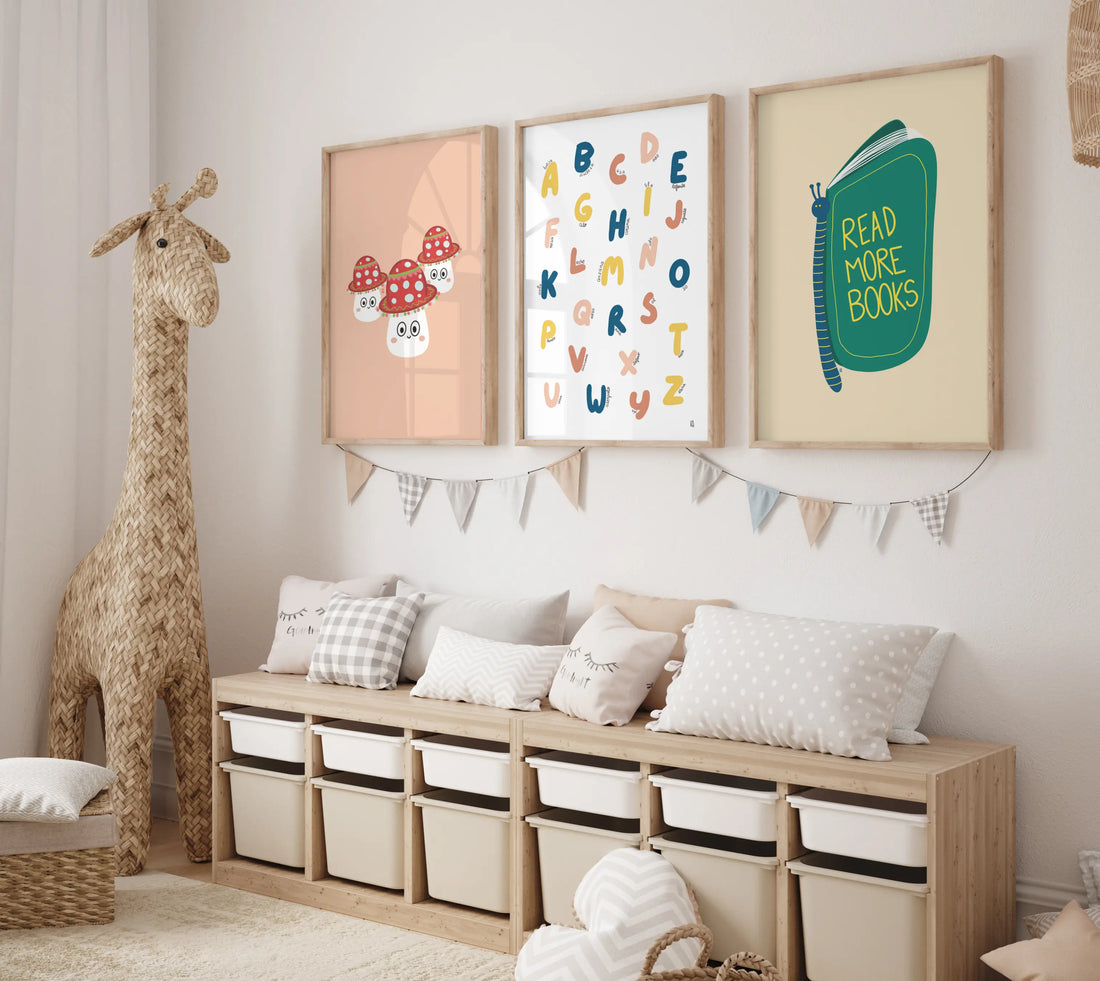
DIY: how to create a children's reading nook with decorative prints
Reading time: 10 minutes | Published by Kago Studio
Introduction
Creating a children's reading nook is one of the best investments you can make in your child's development. A dedicated reading space not only fosters a love for books but also stimulates imagination, improves concentration, and creates positive associations with learning.
In this comprehensive article, we will guide you step-by-step to create a magical and functional reading nook that combines comfort, beauty, and visual stimulation through carefully selected decorative prints.
Why create a dedicated reading nook?
Scientifically proven benefits:
Cognitive development: 🧠 Improves concentration by providing a specific space without distractions
📚 Increases reading time by up to 40% according to studies
🎯 Develops routines for independent reading
💡 Stimulates creativity through an inspiring environment
Emotional benefits: 💝 Creates positive associations with books and learning
🏡 Provides a sense of refuge and security
😌 Reduces childhood stress and anxiety
🌟 Fosters independence and self-confidence
Social benefits: 👨👩👧👦 Facilitates quality family time
📖 Promotes conversations about stories
🤝 Develops empathy through narratives
🗣️ Improves vocabulary and oral expression
Project planning: before you start
Assessment of available space
Option A: Children's bedroom
Advantages:
- Privacy and tranquility
- Easy access before bedtime
- Decor coordinated with the rest of the room
Considerations:
- Limited natural light
- Potentially small space
- Possible distractions with toys
Option B: Living room
Advantages:
- More available space
- Better natural light
- Easy parental supervision
Considerations:
- Noise and family distractions
- Need for aesthetic integration with adult decor
- Storage of children's books
Option C: Wide hallway or distributor
Advantages:
- Utilization of underutilized space
- Neutral zone without distractions
- Easy access from any room
Considerations:
- Artificial lighting required
- Foot traffic
- Furniture limitations
Measurements and minimum requirements
Minimum space required:
- Total area: 1.5m x 1.5m (2.25 m²)
- Clear height: Minimum 2m for hanging prints
- Seat depth: 60-80cm
- Minimum width: 80cm for comfort
Essential elements:
- [ ] Comfortable seating (armchair, cushions, bean bag)
- [ ] Adequate lighting (natural + artificial)
- [ ] Book storage (bookshelf, basket)
- [ ] Support surface (small side table)
- [ ] Visual element (decorative prints)
Step-by-step: creating the perfect nook
STEP 1: Space preparation
Week 1: Cleaning and measuring
Day 1-2: Evaluation and planning
- [ ] Measure available space accurately
- [ ] Evaluate natural light at different times of day
- [ ] Identify electrical outlets for additional lighting
- [ ] Photograph area to plan decoration
- [ ] Define total project budget
Day 3-4: Physical preparation of the space
- [ ] Completely clear the selected area
- [ ] Thoroughly clean walls and floor
- [ ] Check condition of paint and surface
- [ ] Plan placement of main elements
Materials needed for this phase:
- Tape measure/measuring tape
- Spirit level
- Pencil for marking
- Cleaning rags
- Vacuum cleaner
Week 2: Base elements
Selection of main seating:
Option A: Children's armchair
💰 Budget: 40-150€
✅ Pros: Ergonomic, durable, professional
❌ Cons: More expensive, less flexible
📏 Typical measurements: 60x60x50cm
🎯 Ideal for: Children 4-10 years old
Option B: Large pouf + backrest
💰 Budget: 40-80€
✅ Pros: Comfortable, adaptable, economical
❌ Cons: Less lumbar support
📏 Typical measurements: 80x80x40cm
🎯 Ideal for: Children 3-8 years old
Option C: Large cushions + structure
💰 Budget: 30-60€
✅ Pros: Very economical, customizable, flexible
❌ Cons: Requires maintenance, less durable
📏 Measurements: Variable as needed
🎯 Ideal for: All ages, large families
Option D: Quality bean bag
💰 Budget: 50-100€
✅ Pros: Very comfortable, conforms to the body, modern
❌ Cons: Difficult to clean, may lose shape
📏 Measurements: Approximately 80x80x80cm
🎯 Ideal for: Children 5+ years old
STEP 2: Perfect lighting
Current lighting analysis
Natural light test:
- Morning (8-10 am): Is it sufficient for reading without straining the eyes?
- Afternoon (2-5 pm): Is there direct glare?
- Evening (6-8 pm): Is artificial light needed?
Lighting solutions:
Option A: Adjustable floor lamp
Ideal features:
- Flexible directional arm
- 3000K LED light (warm)
- Dimmer switch
- Stable anti-tip base
- Long cord (2m+)

💰 Budget: 60-120€
Option B: Wall sconce
Ideal features:
- Installation at 150cm height
- Light directed downwards
- Switch within child's reach
- Design coordinated with decor

💰 Budget: 40-80€ + installation
Option C: Decorative LED string lights
Ideal features:
- Warm white LED
- Rechargeable battery
- Automatic timer
- Child-resistant

💰 Budget: 20-40€
⚠️ Only as a supplement, not main lighting
Recommended combination:
Main lighting (floor lamp/sconce) + Ambient lighting (LED string lights) = Functionality + Magic
STEP 3: Smart book storage
Solutions based on space and age
For children 2-5 years old:
📚 FRONT-FACING SHELF (cover visible)
- Height: 60-80cm maximum
- Capacity: 20-30 books
- Access: Fully autonomous
- Advantage: Stimulates visual selection

Recommended products:
- Montessori front-facing shelf
- Wooden magazine rack
- Organizing boxes with front opening
For children 6-10 years old:
📚 TRADITIONAL SHELF + BOXES
- Height: 100-120cm
- Capacity: 50-100 books
- Organization: By themes/collections
- Advantage: Greater capacity

Suggested organization:
Top shelf: "Aspirational" books
Middle shelf: Current level books
Bottom shelf: Favorite/reread books
For siblings of different ages:
📚 MIXED SYSTEM
- Lower part: Access for small children
- Upper part: Books for older children
- Color code: By age/difficulty
- Mobile boxes: Weekly rotation
DIY: Personalized bookshelf
Materials needed:
- 4 pine wood boards 80x20x2cm
- 2 side panels 100x20x2cm
- Wood screws 4x40mm
- Fischer plugs
- Non-toxic children's paint/varnish
- 120 grit sandpaper
Tools:
- Drill
- Screwdriver
- Measuring tape
- Pencil
- Level
Construction process:
- Sand all pieces until completely smooth
- Mark shelf positions on side panels
- Pre-drill holes to prevent cracks
- Assemble structure with screws
- Apply paint/varnish in 2 coats
- Dry for 24h between coats
- Install on wall with sturdy plugs
⏰ Estimated time: 4-6 hours spread over 2 days
💰 Approximate cost: 40-60€
🎯 Result: Personalized 80x100cm bookshelf
STEP 4: Decorative prints - The magical touch
Strategic selection based on age
For children 2-4 years old:
🎨 RECOMMENDED THEMES:
- Cute animals and soft colors
- Large illustrated alphabets
- Numbers with countable objects
- Scenes from classic fairy tales
- Simple motivational messages

📏 IDEAL SIZES:
- 1 large print (A2/A1) as a focal point
- 2-3 complementary medium prints (A3)
- Placement height: 120-140cm
Example composition for 2-4 year olds:
Main wall of the reading nook:
- Center: "Animal Alphabet" (A2)
- Left: "Numbers 1 to 10" (A3)
- Right: "Sweet Messages" (A3)
- Coordination: Soft and coherent color palette
For children 5-8 years old:
🎨 EVOLVED THEMES:
- Illustrated world maps
- Nature cycles
- Adapted visual history
- Adventure inspiration
- Values and emotions

📏 GALLERY WALL COMPOSITION:
- 4-6 prints of various sizes
- Mix of horizontal/vertical orientations
- Coherent visual story
- Height: 130-160cm
For children 9+ years old:
🎨 SOPHISTICATED THEMES:
- Inspiring literary quotes
- Historical timelines
- World art and culture
- Science and discoveries
- Personal goals and dreams

📏 MATURE INSTALLATION:
- Balanced asymmetrical composition
- Coordinated but varied frames
- Integration with furniture
- Possible periodic rotation
Professional placement techniques
Wall preparation:
- Clean surface with a damp cloth
- Mark visual center (not geometric)
- Make paper templates of actual print size
- Test composition with templates and washi tape
- Photograph result before final marking
- Mark nailing points with a soft pencil
Recommended heights according to child's age:
👶 2-3 years: Center of print 110-120cm from floor
🧒 4-6 years: Center of print 120-130cm from floor
👦 7-9 years: Center of print 130-140cm from floor
👧 10+ years: Center of print 140-150cm from floor
Multiple composition rules:
- Space between prints: 5-15cm depending on sizes
- Horizon line: Maintain visual alignment
- Visual weight: Balance colors and shapes
- Focal point: One clear protagonist print
Ideal Kago Studio products for a reading nook

"Little Reader" composition:
🎨 Main print: "Colorful Alphabet"
- Size: A3 with included frame
- Position: Center of wall, 120cm height
- Function: Pre-reading support and decoration

🎨 Complementary prints: "Butterfly Book"
- Size: A3 unframed
- Position: Right side
- Function: Fly high

🎨 Complementary prints: "Three Mushrooms"
- Size: A3 unframed
- Position: Left side
- Function: Daydream
STEP 5: Additional comfort elements
Textiles and softness
Nook rug:
📏 Recommended size: 120x80cm minimum
🧵 Ideal material: Washable cotton or natural fibers
🎨 Colors: Neutral or coordinated with prints
💰 Budget: 30-80€

Essential features:
- Non-slip for safety
- Machine washable (kids spill)
- Sufficient thickness for floor comfort
- Well-finished edges (no fraying)
Cushions and blankets:
🛏️ SUPPORT CUSHIONS (2-3 units):
- Size: 40x40cm or 50x30cm
- Filling: Hypoallergenic fiber
- Covers: Removable and washable
- Designs: Coordinated with general decor

🧸 READING BLANKET:
- Material: Soft cotton or quality fleece
- Size: 100x140cm (individual child)
- Color: Neutral or with subtle pattern
- Function: Cozy for long reading sessions
Functional side table
Option A: Small round table
📏 Measurements: 40-50cm diameter, 45-50cm height
🎯 Function: Water glass, snacks, books in use
💰 Cost: 25-60€
✨ Advantage: Safety without sharp corners
Option B: Floating shelf
📏 Measurements: 30x15cm, installed 70-80cm height
🎯 Function: Temporary support, less space occupied
💰 Cost: 15-30€
✨ Advantage: Doesn't take up floor space
Option C: DIY box-table
📦 Base: Wooden box 40x30x40cm
🎨 Personalization: Paint + top cushion
💰 Cost: 20-35€
✨ Advantage: Extra storage + additional seating
Full project budget
ECONOMICAL budget (150-250€)
🪑 SEATING:
- Large floor cushions: 40€
- DIY backrest: 20€

💡 LIGHTING:
- IKEA table lamp: 25€
- LED string lights: 15€

📚 STORAGE:
- DIY bookshelf: 50€
- Organizing boxes: 20€

🎨 DECORATION:
- 3 Kago Studio prints: 60€
- Basic frames: 30€

🧸 COMFORT:
- Small rug: 35€
- Cushion + blanket: 25€

💰 TOTAL: 220€
MEDIUM budget (300-500€)
🪑 SEATING:
- Quality children's armchair: 120€

💡 LIGHTING:
- Adjustable floor lamp: 80€
- Wall sconce: 45€

📚 STORAGE:
- Front-facing + traditional shelf: 100€
- Multiple organizers: 35€

🎨 DECORATION:
- 5 varied Kago Studio prints: 150€
- Medium quality frames: 60€

🧸 COMFORT:
- Large quality rug: 70€
- Premium textiles: 45€
- Side table: 40€

💰 TOTAL: 405€
PREMIUM budget (600-1000€)
🪑 SEATING:
- Designer ergonomic armchair: 250€

💡 LIGHTING:
- Multiple LED system: 150€
- Professional installation: 80€

📚 STORAGE:
- Custom design bookshelf: 200€
- Complete organization system: 60€

🎨 DECORATION:
- Full Kago Studio collection: 300€

🧸 COMFORT:
- Designer rug: 150€
- Premium organic textiles: 80€
- Coordinated auxiliary furniture: 100€

💰 TOTAL: 720€
Maintenance and evolution of the space
Weekly maintenance routines
Basic cleaning (15 minutes/week):
- [ ] Vacuum rug and cushions
- [ ] Clean table surfaces and shelf
- [ ] Organize books by established categories
- [ ] Air out cushions and blankets in the sun
- [ ] Check prints (clean frame glass)
Monthly organization (30 minutes/month):
- [ ] Rotate books according to current interests
- [ ] Check lighting (bulb replacement, cleaning)
- [ ] Evaluate ergonomics according to child's growth
- [ ] Update seasonal decoration if applicable
Evolution according to child's growth
Adaptations 2-4 years → 5-7 years:
📚 BOOKS:
- More text, fewer illustrations
- First independent readings
- Series and collections
- Introduce different genres

🎨 DECORATION:
- More visually complex prints
- Expanded educational themes
- Maps, science, adapted history
- More sophisticated motivational messages
Adaptations 5-7 years → 8-10 years:
🪑 FURNITURE:
- Larger or adjustable seat
- Larger side table for homework
- More powerful and directed lighting
- Expanded storage

📖 FUNCTIONALITY:
- Space for writing/drawing
- Area for school projects
- Reading calendar
- Personalized reading reward system
Signs that it needs updating:
🚨 Physical indicators:
- Child complains about seat comfort
- Difficulty reaching books
- Insufficient lighting (squinting eyes)
- Space feels small/overwhelming
🚨 Usage indicators:
- Less spontaneous time in the nook
- Prefers to read elsewhere
- Books are not organized (can't find favorites)
- Decor no longer attracts their attention
Tips to maximize use
Routines that work
Daily reading ritual:
🌅 MORNING ROUTINE (10-15 minutes):
- Upon waking, 10 minutes of free reading
- Choose a book to take to school (recess)
- Connect quiet time before activity

🌆 EVENING ROUTINE (20-30 minutes):
- After snack, before screens
- Individual reading + shared family reading
- Relaxation moment after school day

🌙 NIGHT ROUTINE (15-20 minutes):
- Last activity before sleep
- Relaxing parent-child reading
- Natural transition to sleep
Special activities in the nook:
📚 "SPECIAL STORY TIME":
- Saturday mornings
- Parents read with different voices
- Recreate story scenes with gestures
- Special snacks (popcorn, fruit)

🎭 "READING THEATER":
- Dramatize read stories
- Create simple costumes with house clothes
- Invite siblings/friends as audience
- Foster creativity and oral expression

🏆 "FAMILY BOOK CLUB":
- Everyone reads the same book (age-adapted)
- Weekly discussion meeting
- Vote for next month's book
How to engage reluctant children
Motivational strategies:
For children 3-5 years old:
- Interactive books with textures, sounds, flaps
- Personalized stories where they are the protagonists
- Reading time as a "reward" not an obligation
- Freely choose from 3-4 pre-selected options
For children 6-8 years old:
- Series and collections (create positive addiction)
- Topics of interest (dinosaurs, princesses, football)
- Comics and graphic novels as a bridge
- Take turns reading with adults (alternating pages/paragraphs)
For children 9+ years old:
- Total freedom of choice within appropriate limits
- Connect with movies/series they like
- Bookstagram or personal review blog
- Book exchange with friends
Mistakes to avoid:
❌ Forcing minimum reading time (creates aversion)
❌ Criticizing literary choices (comics "don't count")
❌ Using as punishment ("until you read, you won't...")
❌ Comparing with siblings or friends
Inspiration and additional ideas
Seasonal decorative themes
Spring - "Story Garden":
🌸 COLOR PALETTE: Soft green, pale pink, light yellow
🎨 PRINTS: Flowers, gardens, baby animals, growing plants
🧸 TEXTILES: Subtle floral prints, natural fabrics
💡 LIGHTING: More natural, LED flower string lights
📚 FEATURED BOOKS: Nature, gardens, farm animals
Summer - "Outdoor Adventures":
🌞 COLOR PALETTE: Sky blue, sand, grass green
🎨 PRINTS: Adventure maps, wild animals, oceans
🧸 TEXTILES: Nautical stripes, light fabrics
💡 LIGHTING: Warm, camping style
📚 FEATURED BOOKS: Adventures, travel, exploration
Autumn - "Forest Library":
🍂 COLOR PALETTE: Orange, brown, gold, soft red
🎨 PRINTS: Forests, leaves, forest animals, harvest
🧸 TEXTILES: Velvet, soft wool, earth tones
💡 LIGHTING: More intimate, warm tones
📚 FEATURED BOOKS: Classic tales, legends, mystery
Winter - "Story Refuge":
❄️ COLOR PALETTE: Deep blue, white, silver, pearl grey
🎨 PRINTS: Snowy landscapes, stars, arctic animals
🧸 TEXTILES: Thick blankets, furry cushions, cool colors
💡 LIGHTING: Soft, Nordic hygge style
📚 FEATURED BOOKS: Winter tales, Christmas, snow adventures
Personalizations according to child's personality
For introverted children:
- More enclosed space (screen, curtains)
- Soft and relaxing colors
- Dimmable soft lighting
- Extra soft textiles (sense of refuge)
- Prints of tranquil landscapes, nature
For extroverted children:
- Open space integrated with the rest of the house
- Vibrant and energetic colors
- Powerful lighting for activity
- Changing decor (frequent rotation)
- Prints of adventures, dynamic characters
For creative children:
- Whiteboard or panel for drawings inspired by readings
- Accessible art materials (pencils, paper)
- Artistic prints of varied techniques and styles
- Exhibition space for their own creations
- Art books, crafts, artist biographies
For scientific children:
- Educational prints of the solar system, anatomy, maps
- Interactive elements (magnifying glasses, globes)
- Encyclopedias and accessible knowledge books
- Laboratory-style lighting (white, powerful)
- Decor inspired by exploration and discovery
✨ Want more options?
👉 Check out all our unframed prints here and our framed prints here.